
Liver Organoids
Accurate, reproducible human liver disease modeling and drug discovery.
Why Researchers are Adopting Liver Organoid Models for Disease Research and Drug Discovery
Liver organoids are increasingly used as disease models and drug screening platforms for liver cancers such as hepatocellular carcinoma, metabolic dysfunction-associated steatotic liver disease (MASLD), drug-induced liver injury (DILI) and degenerative cirrhosis, as well as inherited cholangiopathies including Alagille syndrome. Temporally timed supplementation of growth factors and small molecules supports directed differentiation of cultures through defined developmental intermediates, including definitive endoderm, then hepatoblasts, before they terminally differentiate into hepatocyte-like and cholangiocyte-like (bile duct) cells. These models can more accurately recapitulate human biology and liver disease progression than traditional 2D cultures or animal models. R&D Systems solutions support the generation and analysis of highly reproducible human induced pluripotent stem cell-derived liver organoid models.
Liver Organoids at a Glance
- Mimic key features of human liver tissue, including metabolic and detoxification functions
- Generated from iPSCs, adult stem cells, or patient-derived cells
- Support hepatotoxicity and metabolism studies
- Enable precision medicine research
- Offer greater physiological relevance than many 2D culture systems

Key Advantages of Liver Organoid Models
- Liver organoids derived from human cells mimic the native liver environment and express human-specific metabolic enzymes (e.g. cytochrome P450 family).
- Liver organoids grown from patient-derived cells possess the patient’s exact genetic background, enabling the development of personalized medicine.
- When cultured consistently, organoids can be scaled to test thousands of chemical compounds simultaneously, compressing the timeline for early-stage drug testing and discovery from years to weeks.


Overcoming Challenges of Liver Organoid Models
Despite their promise, liver organoids remain technically demanding, often limiting reproducibility and translational utility. Key challenges include:
- Consistently achieving a complex heterogeneous cellular composition to mimic the human liver can be difficult. Minimize your organoid variability with reliable, high-quality R&D Systems matrices, cytokines, media, and supplements.
- Partial maturation and incomplete differentiation limit organoid functionality. Ensure proper cell differentiation with our well-cited small molecules and growth factors. Then verify cell phenotypes at multiple intermediate steps with our validated flow cytometry panels.
- Scalability for high throughput drug screening can be constrained by culture time, cost, and reproducibility. Reliably scale your organoid cultures and control time and costs by partnering with an experienced 2D and 3D organoid reagent supplier.
Why Liver Organoid Researchers Choose R&D Systems
Deep Experience in Stem Cell and Organoid Biology
Build liver organoid workflows with validated reagents trusted by stem cell and organoid researchers for consistent performance and reproducible culture. R&D Systems offers extensively cited growth factors, cytokines, and small molecules used across published protocols.
Supply Chain Security
Count on reliable product availability and lot continuity to support uninterrupted research from discovery through scale-up. Source key components for liver organoid culture, differentiation, and analysis from a single supplier.
Full Workflow Support
Access decades of cell biology expertise with technical guidance, protocols, and troubleshooting tailored to each stage of your liver organoid workflow.
End-to-End Solutions for the Liver Organoid Workflow
R&D Systems reagents and analytics platforms offer comprehensive solutions for culturing and analyzing highly reproducible liver organoids.
Cell Culture Solutions
Recombinant Proteins
Small Molecules | Recommended Markers
Disease Panel Markers
|
Growth factors reconstitute the stem cell niche in vitro. Specifically, Wnt3a supports initiation from freshly isolated ductal cells, while R-Spondin 1 works to sustain Wnt signaling throughout expansion alongside EGF, FGF-10, and HGF. Directed differentiation requires precisely timed signals as stem cells undergo directed differentiation. Many of these cues are delivered through proteins that are labile and degrade under heat, forcing researchers to perform daily media changes and leaving open questions about true growth factor concentrations over time in culture, which has consequences on differentiation efficiency, and therefore model fidelity. Heat-stable growth factors, such as FGF-10 HS, maintain receptor occupancy and signaling even at 37 °C, ensuring the differentiation cues these cultures require to faithfully model human development continue to persist throughout differentiation and culture maturation.
In diseased organoids such as for Alagille syndrome (ALGS), hepatocyte markers are largely preserved while cholangiocyte markers decrease. Organoids from ALGS iPSCs retain CK18+ expressing cells but formed to produce very few CK7+ cells and no tubular structures, as well as showing reductions in CD26+, CK7+ and CFTR+ cell populations.
Notable Published Protocols
Broutier, L. et al. (2016) Nature Protocols 11:1724.
Guan, Y. et al. (2017) JCI Insight 2:17.
Huch, M. et al. (2015) Cell 160:299.
Koike, H. et al. (2019) Nature 574:112.
Ogawa, M. et al. (2015) Nat. Biotechnol. 33:853.
Takebe, T. et al. (2013) Nature 499:481.
The Organoid Culture Handbook

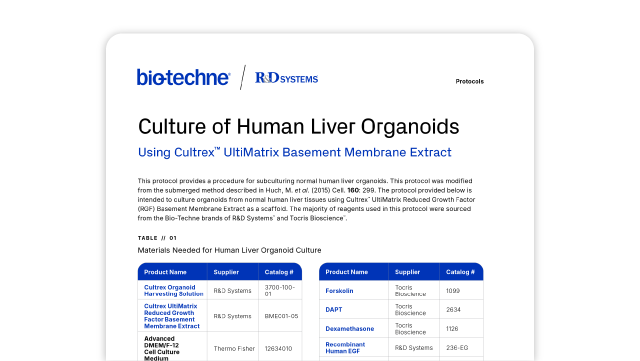
Your guide for consistent organoid culture! Find tissue-specific protocols, troubleshooting tips, and key reagents for organoid and 3D cell culture.
Cell Culture & Organoid Solutions

Quality liver organoid reagents are essential for establishing consistent cultures and supporting healthy cell growth, functionality, and viability.
What is a liver organoid?
A liver organoid is a three-dimensional (3D) cell culture model that recapitulates key structural and functional features of the liver. Liver organoids can be generated from adult tissue-derived stem cells, induced pluripotent stem cells (iPSCs), embryonic stem cells (ESCs), or primary human hepatocytes, where they self-organize into multicellular structures that resemble aspects of native liver tissue. Depending on the differentiation strategy, liver organoids may contain hepatocyte-like cells, cholangiocyte-like cells, or multiple liver cell populations. Protocols starting from iPSCs typically progress through definitive endoderm, along with a hepatoblast stage. The hepatoblast stage is a potent progenitor that can give rise to both hepatocytes and cholagiocytes (bile duct cells) before terminal maturation.
What are liver organoids most often used for?
Liver organoids are widely used to study liver development, physiology, and disease in a more physiologically relevant model than traditional two-dimensional cultures. Common applications include:
- Modeling inherited and acquired liver diseases
- Drug metabolism and hepatotoxicity studies
- Drug discovery and efficacy screening
- Host-pathogen interactions, including viral hepatitis
- Liver fibrosis and steatosis research
- Precision medicine using patient-derived organoids
- Regenerative medicine and cell therapy research
Because they retain many characteristics of native liver tissue, organoids provide researchers with models that can better predict in vivo responses.
What challenges exist in liver organoid culture?
Although liver organoids provide significant advantages over conventional cell culture models, several challenges remain.
One of the primary limitations is achieving fully mature hepatic function. Many human hepatic organoids retain fetal-like characteristics, including lower expression of cytochrome P450 enzymes and reduced metabolic activity. In addition, most liver organoids lack the complex multicellular environment found in vivo, including Kupffer cells, hepatic stellate cells, endothelial cells, and functional vasculature.
Researchers may also encounter challenges related to:
- Batch-to-batch variability in extracellular matrix materials
- Limited nutrient and oxygen diffusion in larger organoids
- Maintaining long-term culture stability
- Standardizing differentiation efficiency between experiments
- Modeling chronic liver diseases that depend on complex immune and stromal interactions
Careful optimization of culture conditions and reagent selection can help improve experimental consistency.
As mentioned above, consistently achieving a complex heterogeneous cellular composition of human liver in organoid models also remains challenging. Most protocols can produce hepatocyte and cholangiocyte cells, but are often incomplete, lacking the non-parenchymal cell (NPC) compartment. To successfully model complex liver pathologies such as fibrosis or inflammation, models require coordinated intercellular communication between Kupffer cells (resident macrophages that coordinate an immune/inflammatory response), endothelial cells (vascular line formation, respond strongly in tissue regeneration and scarring), and stellate cells (primary cell type that drives collagen deposition in fibrosis). While co-culture approaches designed to add these lineages are increasingly being used to close this gap, there is still work to be done to ensure these models accurately represent human physiology, especially when attempting to recreate disease pathologies in the lab.
How can I improve reproducibility in liver organoid culture?
Improving reproducibility begins with reducing variability throughout the workflow. Consider the following best practices:
- Use highly characterized, lot-consistent extracellular matrices.
- Select optimized, validated media formulations and recombinant growth factors.
- Standardize organoid seeding density, passaging intervals, and differentiation protocols.
- Monitor organoid morphology and growth throughout culture.
- Minimize technical variation by following consistent handling procedures.
- When possible, use defined or synthetic matrices to reduce variability associated with biologically derived extracellular matrices.
Combining standardized protocols with high-quality reagents can improve consistency across experiments and between laboratories.
What tools support liver organoid analysis?
A variety of molecular and cellular analysis tools can be used to characterize liver organoids throughout development and differentiation.
Common approaches include:
- Immunofluorescence and immunohistochemistry for hepatocyte and cholangiocyte markers
- ELISAs for secreted proteins such as albumin
- qPCR and RNA sequencing for gene expression profiling
- Flow cytometry for cell population analysis
- Live-cell imaging to monitor organoid growth and morphology
- Functional assays measuring albumin secretion, urea production, bile acid transport, and cytochrome P450 enzyme activity
Combining structural, molecular, and functional assays provides a comprehensive assessment of liver organoid identity and performance.
What extracellular matrix is best for liver organoid culture?
Basement membrane extracts (BMEs) remain the most widely used extracellular matrix for establishing and expanding liver organoids because they provide the biochemical and mechanical cues necessary for organoid formation.
Researchers are increasingly adopting next-generation extracellular matrices with improved lot-to-lot consistency or synthetic hydrogels that offer greater control over matrix composition and stiffness. The optimal matrix depends on the organoid type, differentiation stage, and experimental application.
Looking for a synthetic alternative? Try Cultrex Synthetic Hydrogel.
Can liver organoids be used for drug screening?
Yes. Liver organoids have become valuable tools for evaluating drug efficacy, metabolism, and toxicity because they more closely mimic native liver biology than conventional monolayer cultures.
They are particularly useful for:
- Hepatotoxicity screening
- Drug metabolism studies
- Personalized drug response testing using patient-derived organoids
- Evaluating therapeutic candidates during preclinical development