IL-7 Signaling Pathways and their Primary Biological Effects in Different Immune Cell Types
T Cell Development
Precursor
T Cell Development
Homeostatic Proliferation
T Cell Proliferation
Proliferation
& Survival of Memory T Cells
Effector T Cells
Memory T Cells
Proliferation/Survival
TCR & Distal Ig Heavy Chain Loci
RAG Expression
Chromatin Accessibility
V(D)J Recombination
TCR gamma Expression
Variable Ig Synthesis
V(D)J Recombination
B Cell Development
B Cell Development
Overview of IL-7 Signaling and its Primary Biological Effects in Different Immune Cell Types
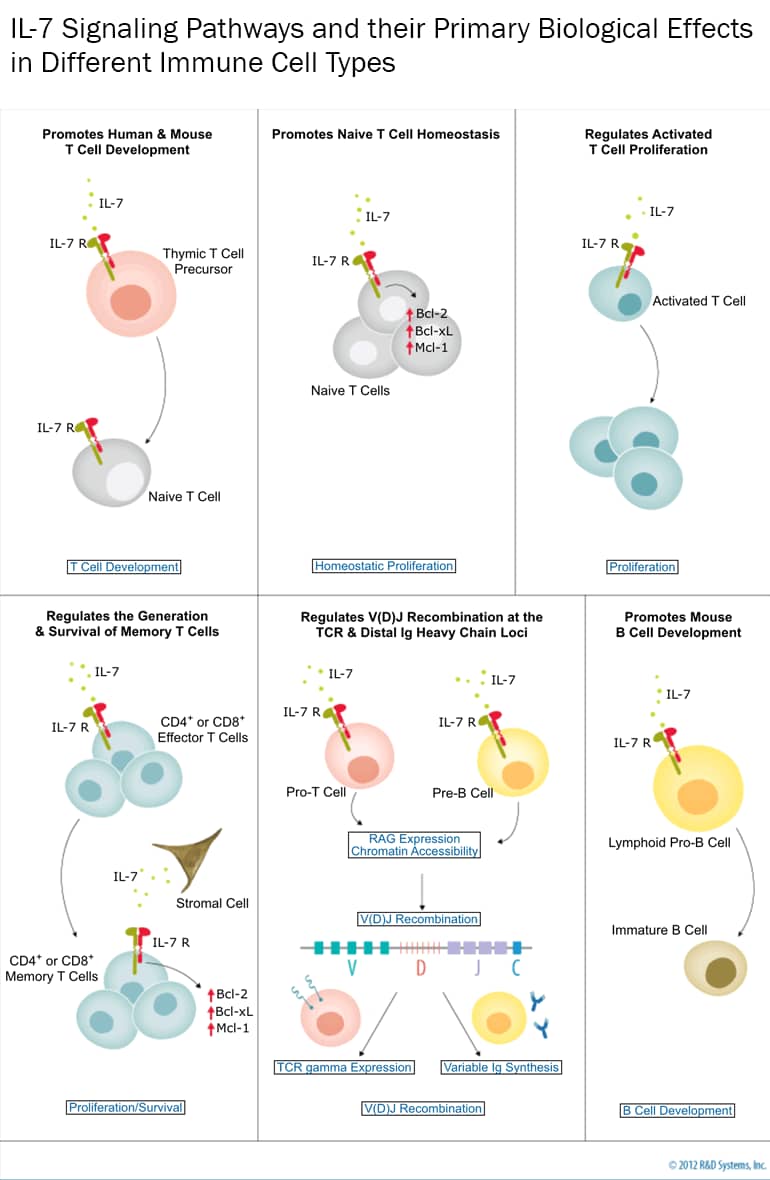
Interleukin-7 (IL-7) is a type I glycoprotein that is predicted to form a four alpha-helix structure with a hydrophobic core. It is produced primarily by stromal cells and exerts its effects through a receptor complex consisting of IL-7 R alpha and common gamma-chain/IL-2 R gamma. IL-7 signaling is essential for the establishment and maintenance of normal immune system functions. It is required for mouse and human T cell development and homeostatic proliferation, mouse B cell development, and the generation of CD4+ and CD8+ memory T cells. IL-7 R alpha-deficient mice have reduced numbers of thymocytes, impaired T cell and B cell development, and lack gamma delta T cells, a small subset of T cells found in epithelium-rich tissues. The requirement of IL-7 for T cell survival has been partially attributed to its ability to induce expression of the anti-apoptotic Bcl-2, Bcl-xL, and Mcl-1 proteins. In addition, IL-7 plays a role in regulating V(D)J recombination at the TCR gamma, TCR beta, and immunoglobulin heavy chain loci.
To learn more, please visit our Common gamma Chain Receptor Family Research Area.