
Matched Pairs and ELISA-validated Antibodies to Accelerate Immunoassay Development
Build reliable immunoassays faster with antibodies that work together
Matched antibody pairs are capture and detection antibodies selected to bind non-overlapping epitopes of the same target, providing a starting point for sandwich ELISA and custom immunoassay development. Whether you’re working in a challenging sample matrix, targeting an epitope blocked by your therapeutic, or moving to a new assay platform, matched pairs can help you move efficiently from screening into assay optimization.
In-house immunogen design, antibody-pair testing, and use across established platforms help make R&D Systems™ antibodies a reliable choice for immunoassay development. These antibodies are used in Quantikine™ ELISA kits, DuoSet™ ELISA Development Kits, Luminex® assays, and Simple Plex assays, providing proof of performance across immunoassay formats and development workflows.
Our matched antibody pairs are compatible with:
- Plate-based sandwich ELISA
- Multiplex Platforms (Luminex® xMAP, Meso Scale Discovery (MSD), Quanterix Simoa, Gyros)
- See selected citations for antibodies used on MSD and Quanterix Simoa
- Simple Plex Open Cartridge
Lateral flow assay development


Featured Matched Pairs | ||||||||
| Target | Species | Immunogen | Sample Type* | Capture Antibody | Detection Antibodies | Protein Standard | Additional ELISA Antibodies | |
| GM-CSF | Human | GM-CSF (Ala18-Glu144) Accession # P04141 | Human lymphoid follicle, human serum, cell culture supernatants | MAB615 (Clone # 6804) | MAB215 - Unconjugated BAM215 - Biotinylated (Mouse IgG1 # 3209) | 215-GM | NBP3-28666, NBP3-28668, NBP3-28667, NBP3-28565, NBP3-28866, NBP3-28878, NB600-632 | |
| Complement Component C5a | Human | Complement Component C5a (Thr678-Arg751) Accession # P01031 | MAB2037 (Clone # 295003) | MAB20371 - Unconjugated BAM20371 - Biotinylated (Mouse IgG1 # 295009) | 2037-C5 | NBP2-89579, NBP2-89580, NBP2-23498 | ||
| CX3CL1/ Fractalkine | Human | CX3CL1/Fractalkine (Gln25-Arg339) Accession # P78423 | Human serum, human plasma, FBS, cell culture supernatants | MAB3652 (Clone # 81506) | MAB365 - Unconjugated BAM365 - Biotinylated (Mouse IgG1 # 51637) | 365-FR | NBP2-89590, NBP3-28244, NBP1-76467 | |
| IL-15 | Human | IL-15 (Asn49-Ser162) Accession # P40933 | MAB647 (Clone # 34505) | MAB247 - Unconjugated BAM247 - Biotinylated (Mouse IgG1 # 34593) | 247-ILB | NBP3-27966, NBP2-89449, NBP3-28694 | ||
| IL-8/CXCL8 | Canine | IL-8/CXCL8 (Ala23-Pro101) Accession # P41324 | MAB16081 (Clone # 258901) | MAB1608 - Unconjugated BAM16082 - Biotinylated (Mouse IgG1 # 258911) | 1608-CL | |||
| Activin A | Human | Activin A | MAB3381 (Clone # 69403) | MAB3381 - Unconjugated BAM3381 - Biotinylated (Mouse IgG1 # 69403) | 338-AC | NBP3-28238 | ||
| Amphiregulin | Human | Amphiregulin | MAB262 (Clone # 31221) | AF262 - Unconjugated BAF262 - Biotinylated (Polyclonal Goat IgG) | 262-AR | |||
| P-Cadherin | Human | P-Cadherin (Asp108-Gly654) Accession # CAA45177 | MAB861 (Clone # 104805) | AF861 - Unconjugated BAF861 - Biotinylated (Polyclonal Goat IgG) | 861-PC | NBP3-28548, MAB861R | ||
| Siglec-9 | Human | Siglec-9 (Gln18-Gly348) Accession # Q9Y336 | MAB1139 (Clone # 191240) | AF1139 - Unconjugated BAF1139 - Biotinylated (Polyclonal Goat IgG) | 1139-SL | NBP3-14622 | ||
| ST2/IL-33R | Human | ST2/IL-33R (Lys19-Phe328) Accession # BAA02233 | Human ocular fluid, human serum, human plasma, and nasosorption fluid | MAB523 (Clone # 97203) | AF523 - Unconjugated BAF523 - Biotinylated (Polyclonal Goat IgG) | 523-ST | ||
*Sample type information is derived from in-house validation data and peer-reviewed publications identified through literature database searches and automated citation analysis.
Establish a working assay
• Begin with matched pairs selected to recognize non-overlapping epitopes in sandwich immunoassays.
• Use antibodies and protein standards developed together to establish signal with a reliable baseline.

Figure 1. BCMA/TNFRSF17 Matched Pair Standard Curve performance. Recombinant human BCMA/TNFRSF17 protein (Catalog # 193-BC) was serially diluted (2-fold) and captured with Mouse Anti-Human BCMA/TNFRSF17 Monoclonal Antibody (Catalog # MAB10763). Detection was performed using biotinylated Mouse Anti-Human BCMA/TNFRSF17 Monoclonal Antibody (Catalog # MAB107622).

Figure 2. Angiopoietin-2 Matched Pair Standard Curve performance. Recombinant human Angiopoietin-2 (Catalog # 623-AN) was serially diluted (2-fold) and captured with Mouse Anti-Human Angiopoietin-2 Monoclonal Antibody (Catalog # MAB098). Detection was performed using biotinylated Mouse Anti-Human Angiopoietin-2 Antibody (Catalog # BAM0981).
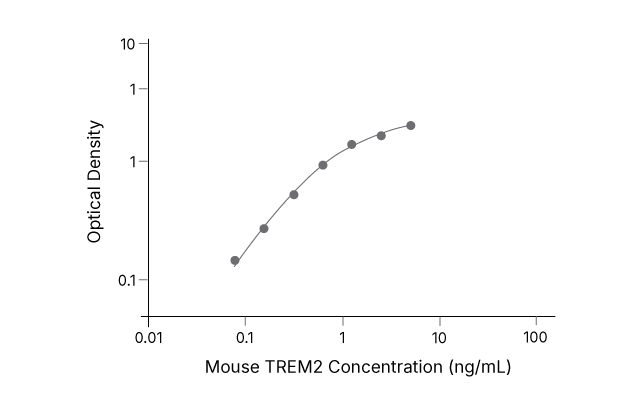
Figure 3. TREM-2 Matched Pair Standard Curve Performance. Recombinant mouse TREM2 protein was serially diluted (2-fold) and captured with Sheep Anti-Mouse TREM2 Polyclonal Antibody (Catalog # AF1729). Detection was performed using Sheep Anti-Mouse TREM2 Biotinylated Polyclonal Antibody (Catalog # BAF1729).
Optimize assay performance
- Swap in alternative antibodies to the same target when signal is weak, inconsistent, or matrix-affected.
- Adjust antibody format or labeling to match your assay platform and workflow.
- 97% of Quantikine™ ELISA kits use R&D Systems antibodies
- 94% of Luminex® assays use R&D Systems antibodies
- 90% of Simple Plex assays use R&D Systems antibodies
- Find additional ELISA validated antibodies to refine performance under real sample conditions.
PDGFRβ
- PMID: 32301266 —R&D Systems reagents (PDGFRβ Capture Antibody #AF385, PDGFRβ Detection Antibody #BAF385, and recombinant PDGFRβ standard #385‑PR/CF) were used in an optimized MSD-based assay to reliably detect and quantify PDGFRβ in human cerebrospinal fluid (CSF).
- MAB1263, MAB385, BAF1042, also included in screen.
CSF-1 R/CD115
- PMID: 24339731 — R&D Systems reagents (M-CSF R Detection Antibody #AF329) was used in an optimized semi-quantitative MSD-based assay to detect CSF‑1R (FMS/p‑FMS) in human PBMC lysates.
p75NTR
- PMID: 40629851 — R&D Systems reagents (p75NTR Detection Antibody #AF357 and recombinant NGFR standard #367‑NR‑050/CF) were used in an optimized MSD‑based assay to detect and quantify urinary p75NTR, supporting sensitive, quantitative measurement of the biomarker in human urine samples.
c‑MET (soluble c‑MET ectodomain; sMET)
- PMID: 34180036 — R&D Systems reagents (c‑MET Capture Antibody #AF276, c-Met Detection Antibody #BAF358, and recombinant protein standard c‑MET #358‑MT) were used in an optimized MSD‑based electrochemiluminescence assay to quantify soluble biomarker levels in human plasma samples.
HGF (hepatocyte growth factor)
- PMID: 34180036 — R&D Systems reagents (HGF Capture Antibody #MAB694, HGF Detection Antibody #AF294, and recombinant protein standard HGF #294‑HG) were used in an optimized MSD‑based assay to quantify soluble biomarker levels in human plasma samples.
PTN (pleiotrophin)
ApoB‑100 (Apolipoprotein B‑100)
- PMID: 37252755 — R&D Systems reagents (ApoB‑100 Capture Antibody #MAB4124 and ApoB‑100 Detection Antibody #MAB41242 were used in Simoa‑based digital ELISA assays to quantify lipoproteins supporting sensitive, quantitative assessment of EV isolation purity.
- Albumin DuoSet #DY1455 was also used to detect free protein contamination.
IL-6
- PMID: 34094160 — R&D Systems reagents (IL‑6 Capture Antibody #MAB206, IL‑6 Detection Antibody #BAF206, and recombinant protein standard IL-6 #206-IL) were used in Quanterix Simoa HD‑X digital immunoassays to quantify IL‑6 in a multiplex Simoa workflow, enabling ultrasensitive protein measurement alongside other analyte classes in biofluids (blood, urine, CSF, saliva).
ACE-2
FAQs:
What are matched antibody pairs?
Matched antibody pairs are carefully selected combinations of two antibodies that specifically bind to different epitopes on the same target protein—one for capture and one for detection. These pairs are optimized for use in sandwich ELISA assays, enabling highly specific and sensitive quantification of target proteins in complex biological samples such as serum, plasma, or cell culture supernatants. R&D Systems™ offers a wide range of high-affinity matched antibody pairs designed for reproducible immunoassay development and protein quantification workflows.
Can I customize an antibody pair?
Yes, R&D Systems™ offers custom antibody pairing services to support your specific assay development needs. If you're targeting a novel protein, working with a rare sample type, or need a specific detection format, our team can help identify and validate a custom capture and detection antibody combination tailored for your assay platform—whether you're building a sandwich ELISA, a multiplex assay, or another immunoassay format.
Are your antibody pairs validated for ELISA?
Yes, all R&D Systems™ matched antibody pairs are rigorously validated for use in ELISA applications. Validation includes testing for sensitivity, specificity, dynamic range, and inter-lot consistency to ensure reliable and reproducible results. Many of our antibody pairs are also backed by supporting data, including standard curves, recommended protocols, and validated sample types, making them ideal for both discovery research and assay development.
Can matched antibody pairs be used on MSD or Quanterix Simoa platforms?
Yes. Matched antibody pairs can be used on MSD and Quanterix Simoa platforms. They are platform‑agnostic reagents and have been applied across multiplex and ultra‑sensitive immunoassay systems, with assay‑specific optimization as needed.