
Small Molecules for Organoid Culture
Organoids are 3D tissue culture models that allow for the study of organs in vitro. Derived from pluripotent stem cells, extracellular matrix and other supporting co-culture cells, and with the right culture conditions, organoids can form different cell types found in organs. The cells can organize into a similar structure as the tissue of origin and function similarly to the organ type being modeled.
Small molecules are an essential tool for organoid culture due to their ease of use, controlled production methods and quality. R&D Systems portfolio provides a comprehensive selection of small molecules for the growth and maintenance of organoid and 3D tissue culture.


Benefits of Using Small Molecules
Small molecules have several qualities that make them useful tools in the growth and maintenance of organoids:
- Ease of use: cell-permeability permits simple probe delivery
- Repeatable: exceptional quality ensures consistent results
- Good value: cost effective compared to viral vectors and antibody kits
- Tunable: concentration-dependent effects
- High quality: low lot-to-lot variability and high purity >98%
- Temporal control: rapid removal via media exchange
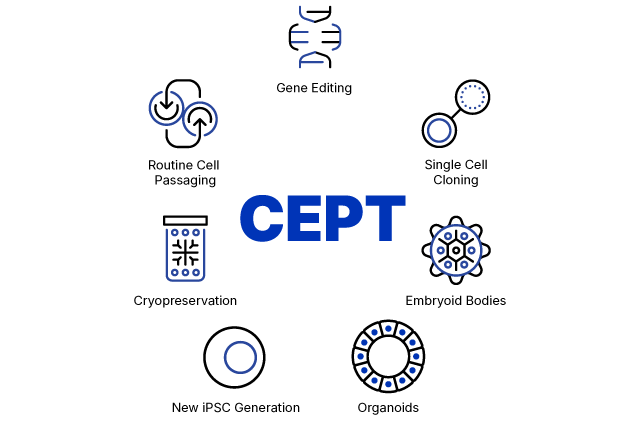
CEPT Cocktail Kit
- Easy to use cell culture supplement for self-renewing pluripotent stem cells and their differentiated lineages
- Improves overall survival of cells for routine long-term passage, cryopreservation, single cell cloning and organoid formation
| Product | Catalog # | Functions |
| A 83-01* | 2939 | Selective inhibitor of TGF-βRI, ALK4/ALK7 |
| AGN 193109* | 5758 | High affinity pan-RAR antagonist |
| AM 580* | 0760 | RARα agonist |
| L-Ascorbic acid* | 4055 | Cav3.2 channels inhibitor |
| N-Acetylcysteine | 7874 | Commonly used in multiple stages of organoid generation |
| BDNF (human) | 2837 | Activated TrkB and p75 neurotrophin receptors |
| CEPT Cocktail Kit | 7991 | Cell culture supplement for improving stem cell survival containing Chroman 1, Emricasan, Polyamine Supplement, trans-ISRIB and DMSO |
| CHIR 99021** | 4423 | Selective GSK-3 inhibitor, Wnt activator |
| CHIR 99021 in solution | 8170 | Ready-to-use 10mM solution of CHIR 99021 pre-dissolved in DMSO |
| Compound E | 6476 | γ-secretase and Notch pathway inhibitor |
| DAPT* | 2634 | γ-secretase inhibitor |
| DBZ* | 4489 | γ-secretase aspartyl protease inhibitor |
| Dexamethasone* | 1126 | Anti-inflammatory glucocorticoid |
| DMSO, Cell Cryopreserve Grade | 7726 | Protective agent for freezing of cell cultures |
| Dorsomorphin | 3093 | AMPK and BMP type 1 receptor inhibitor |
| endo-IWR 1* | 3532 | Wnt/β-catenin signaling inhibitor |
| Erlotinib Hydrochloride | 7194 | EGFR tyrosine kinase inhibitor |
| Forskolin* | 1099 | Adenylyl cyclase activator |
| Galunisertib | 6956 | ALK4/ALK5 (TGFβRI) inhibitor |
| Gastrin I (human) | 3006 | Selective CCK2 agonist |
| Heparin sodium salt | 2812 | Anticoagulant |
| Hepes | 3173 | Multipurpose HEPES buffer; used in 3D cell culture |
| Iressa | 3000 | Selective EGFR inhibitor |
| ISX 9* | 4439 | Neurogenic agent |
| IWP 2 | 3533 | Wnt pathway & PORCN inhibitor |
| IWP 4 | 5214 | Wnt/β-catenin signaling inhibitor |
| LDN 193189** | 6053 | Selective ALK2/ALK3, Smad1/5/8 inhibitor |
| LDN 193189 in solution | 8150 | Ready-to-use 10mM solution of LDN 193189 pre-dissolved in water |
| Nicotinamide* | 4106 | PARP-1 inhibitor |
| PD 0325901 | 4192 | MEK1/2 inhibitor |
| PD 0332991 | 4786 | Cdk4/6 inhibitor |
| Prostaglandin E2 | 2296 | Promotes hematopoietic stem cell expansion |
| RepSox* | 3742 | TGF-βRI inhibitor |
| Retinoic Acid* | 0695 | Retinoic acid receptor agonist |
| Rosiglitazone | 5325 | Selective PPARγ agonist |
| RS 246204 | 8853 | R-Spondin-1 substitute used to initiate small intestinal organoids |
| SANT-1 | 1974 | Hedgehog pathway inhibitor |
| SB 202190 | 1264 | Selective p38 MAPK inhibitor |
| SB 431542** | 1614 | Selective TGF-βRI, ALK4/ALK7 inhibitor |
| Staurosporine* | 1285 | Non-selective protein kinase inhibitor |
| T3* | 6666 | Thyroid hormone |
| Thiazovivin | 3845 | ROCK inhibitor; improves the efficiency of fibroblast reprogramming and induction of iPSCs |
| TM2 TEAD inhibitor | 7917 | TEAD-mediated Hippo/Yap signaling inhibitor |
| Tocriscreen Stem Cell Library | 7340 | A library of 120 stem cell compounds to explore stem cell reprogramming, differentiation, proliferation and signaling |
| XAV 939** | 3748 | Tankyrase inhibitor |
| WIKI4 | 4855 | Tankyrase inhibitor |
| Wnt-C59 | 5148 | PORCN inhibitor |
| Y-27632 | 1248 | Selective ROCK inhibitor; inhibits ROCK1 (p160 ROCK) and ROCK2; stem cell freezing (cryopreservation) media component |
| Y-27632 in solution | 7000 | Sterile-filtered 10 mM solution of Y-27632, selective ROCK inhibitor, pre-dissolved in water |
*Ancillary Material Grade Small Molecules and **GMP small molecules are available
Fluorescent Dyes for Organoids and 3D Cell Culture
R&D Systems brand offers a wide range of fluorescent dyes that can be used for organoid and 3D cell culture, enabling to visualize cellular structures, track dynamic cellular processes, assess various functional parameters, and perform high-content imaging and phenotypic analysis with compatibility for advanced microscopy and imaging platforms.
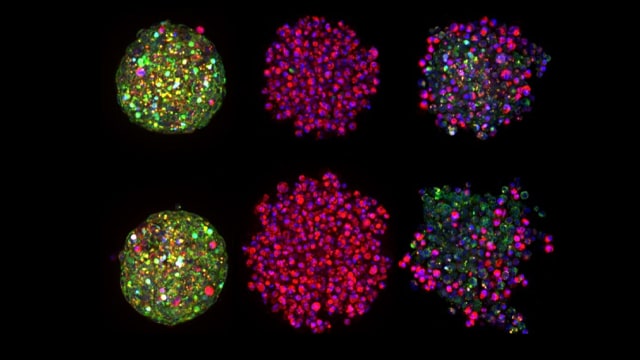
Phenotypic Probes
Mix-and-read fluorescent dyes for long-term live-cell imaging, suitable for iPSCs and organoids. These multi-chromatic dyes provide high-density biological information for live-cell phenotypic profiling.
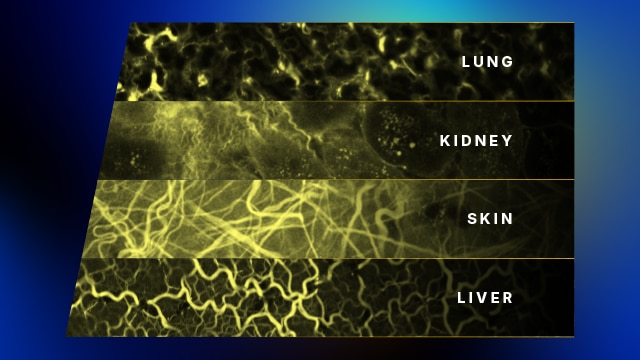
Wash-free Imaging of Extracellular Matrix in Live Tissues
With Rhobo6 ECM Dye, a cell-impermeable glycan-binding fluorophore
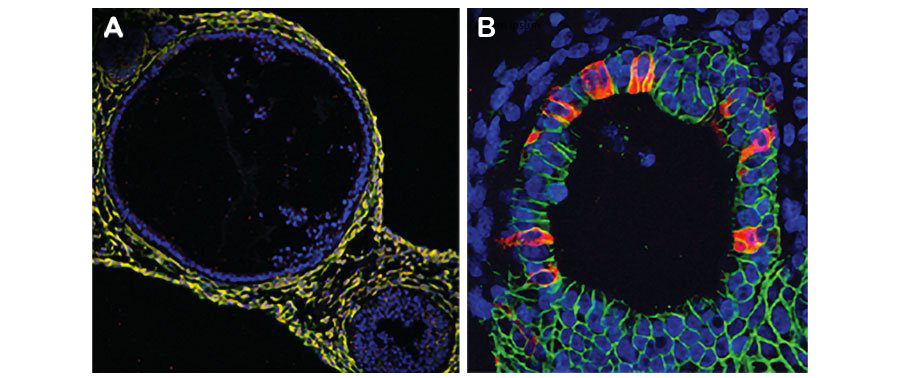
Culture and Characterization of iPSC-derived Human Intestinal Organoids.
iPSC-derived human intestinal organoids were cultured using Y-27632 dihydrochloride (Catalog # 1254), SB 202190 (p38 MAPK Inhibitor) (Catalog # 1264), N-Acetylcysteine (Catalog # 7874), A 83-01 (Catalog # 2939), Nicotinamide (Catalog # 4106), along with the other reagents listed in the human intestinal organoid culture protocol. (A) Human intestinal organoids were stained using a Human/Mouse/Rat Vimentin Antibody (Catalog # MAB2105; green) and a Human/Mouse Desmin Antibody (Catalog # AF3844; red) to visualize myofibroblast cells and counterstained with DAPI (Catalog # 5748; blue). (B) Human intestinal organoids were stained using Human/Mouse E-Cadherin Antibody (Catalog # AF748; green) and a MUC2 Antibody (Catalog # NBP2-44431; red) and counterstained with DAPI (Catalog # 5748; blue).
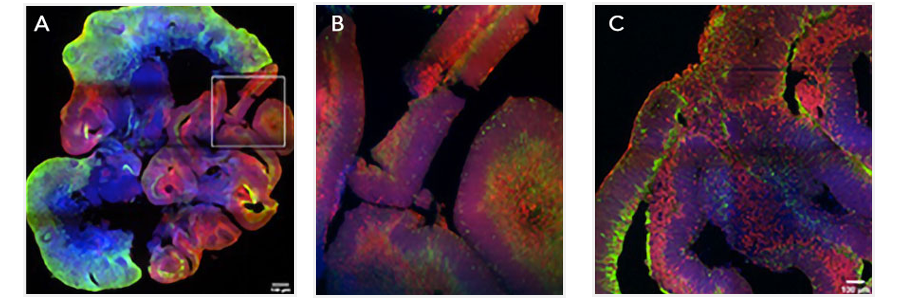
Culture and Characterization of iPSC-derived Cerebral Organoids.
iPSC-derived cerebral organoids (day 45) were cultured using Cultrex UltiMatrix RGF Basement Membrane Extract (Catalog # BME001-05) and brain organoid culture medium, which includes Y-27632 dihydrochloride (Catalog #1254), along with other reagents listed in the brain organoid culture recipe. Cerebral organoids were stained for Syto6 (blue), Pax6 (red), and Vimentin (green). (A) Image taken at 4x magnification. (B) An enlarged view of the area shown within the white box in part A of the figure. (C) Image taken at 15x magnification. Images courtesy of LifeCanvas Technologies.
The Organoid Handbook
This handbook highlights some of the notable publications that have used organoids to investigate questions about development, disease, or drug safety. Additionally, it includes recipes and links to the key reagents that our own in-house scientists have used to establish the culture conditions for different types of organoids.
Small Molecules for Stem Cell Research Guide
Stem cells possess the unique abilities of self-renewal and differentiation, making them a crucial resource in medical research and regenerative therapies. This brochure serves as a guide to the application of small molecules in stem cell research, covering their roles in reprogramming, self-renewal, differentiation, organoid generation, and regenerative medicine.
Fluorescent Dyes and Probes Product Guide
This Fluorescent Dyes and Probes Product Listing provides a comprehensive list and background to the use of fluorescent dyes, including fluorescent probes and reagents for organoids and 3D cell culture imaging.
Organoid Protocols
These protocols offer a guide to culturing organoids for various organs (intestines, lung, liver, and more), including equipment, R&D Systems reagents, steps for culturing organoids and resources to relevant published protocols.