
R&D Systems' Human Apoptosis Array Kit (Catalog # ARY009) is a rapid, sensitive, and economical tool to simultaneously detect the relative levels of expression of 35 apoptosis-related proteins in a single sample. No specialized equipment is necessary.
Best Seller
Proteome Profiler Human Apoptosis Array Kit
R&D Systems | Catalog # ARY009
Contains 4 membranes - each spotted in duplicate with 35 different apoptosis antibodies

Loading...
Key Product Details
Species
Human
Product Summary for Proteome Profiler Human Apoptosis Array Kit
Kit Summary
A membrane-based antibody array for the parallel determination of the relative levels of human apoptosis-related proteins. Validated for analyte detection in cell lysates.
Key Benefits
- Detects 35 human apoptosis-related proteins simultaneously
- Requires no specialized equipment
Principle of the Assay
The Proteome Profiler Human Apoptosis Array Kit is a membrane-based sandwich immunoassay. Capture antibodies spotted in duplicate on nitrocellulose membranes bind to specific target proteins present in the sample (Step 1). Captured proteins are detected with biotinylated detection antibodies (Step 2) and then visualized using chemiluminescent detection reagents (Step 3). The signal produced is proportional to the amount of the bound analyte.
Why Use an Antibody Array to Detect Apoptosis-Related Proteins?
Determining the expression of multiple proteins in a single sample can be expensive, time consuming and can require specialized equipment. Performing multiple immunoprecipitations and Western blots requires time, labor, and reagents. The use of a multiplex antibody array to detect multiple proteins in a single sample can be cost-effective and also save time and sample.
Kit Contents
- 4 Array Membranes
- 4-Well Multi-dish
- Array Buffers
- Lysis Buffer
- Wash Buffer
- Antibody Detection Cocktail
- Streptavidin-HRP
- Chemiluminescent Detection Reagents
- Transparency Overlay Template
- Detailed Protocol
For a complete list of the kit contents and necessary materials, please see the Materials Provided/Other Supplies Required sections of the product datasheet.
Stability and Storage
Store the unopened kit at 2 °C to 8 °C. Do not use past kit expiration date.
| Simultaneously detect the relative levels of these apoptosis-related proteins in a single sample. | ||
|---|---|---|
| Bad | TRAIL R1/DR4 | PON2 |
| Bax | TRAIL R2/DR5 | p21/CIP1/CDNK1A |
| Bcl-2 | FADD | p27/Kip1 |
| Bcl-x | Fas/TNFSF6 | Phospho-p53 (S15) |
| Pro-Caspase-3 | HIF-1 alpha | Phospho-p53 (S46) |
| Cleaved Caspase-3 | HO-1/HMOX1/HSP32 | Phospho-p53 (S392) |
| Catalase | HO-2/HMOX2 | Phospho-Rad17 (S635) |
| cIAP-1 | HSP27 | Pro-Caspase-3 |
| cIAP-2 | HSP60 | SMAC/Diablo |
| Claspin | HSP70 | Survivin |
| Clusterin | HTRA2/Omi | TNF RI/TNFRSF1A |
| Cytochrome c | Livin | XIAP |
Assays for analytes represented in the Human Apoptosis Array Kit
| Analyte | Quantikine® ELISA Kits | DuoSet® ELISA Development Systems | DuoSet® IC ELISA Development Systems (Total) | DuoSet® IC ELISA Development Systems (Phospho or Active) |
|---|---|---|---|---|
| Bad | DYC819 | |||
| Bax | DYC820 | |||
| Bcl-2 | DYC827B | |||
| Bcl-x | ||||
| Pro-Caspase-3 | ||||
| Cleaved Caspase-3 | KM300 | DYC835 | ||
| Catalase | ||||
| cIAP-1 | ||||
| cIAP-2 | ||||
| Claspin | ||||
| Clusterin | DCLU00 | DY5874 | DYC2937 | |
| Cytochrome c | DCTC0 | DYC897 | ||
| TRAIL R1/DR4 | ||||
| TRAIL R2/DR5 | ||||
| FADD | ||||
| Fas/TNFSF6 | DFS00 | DY326 | ||
| HIF-1alpha | DYC1935 | |||
| HO-1/HMOX1/HSP32 | DYC3776 | |||
| HO-2/HMOX2 | ||||
| HSP27 | DYC1580 | DYC2314 | ||
| HSP60 | DYC1800 | |||
| HSP70 | DYC1663 | |||
| HTRA2/Omi | ||||
| Livin | ||||
| PON2 | DYC4344 | |||
| p21/CIP1/CDNK1A | DYC1047 | |||
| p27/Kip1 | DYC2256 | |||
| phospho-p53 (S15) | DYC1043 | DYC1839 | ||
| phospho-p53 (S46) | DYC1043 | DYC1489 | ||
| phospho-p53 (S392) | DYC1043 | DYC2996 | ||
| phospho-Rad17 (S635) | ||||
| SMAC/Diablo | DYC789 | |||
| Survivin | DSV00 | DYC647 | ||
| TNF RI/TNFRSF1A | DRT100 | DY225 | ||
| XIAP | DYC822 |
Western blotting antibodies for analytes related to the Human Apoptosis Array Kit
| Analyte | Phospho-Specific Antibodies | Affinity Purified Polyclonal Antibodies (Total) | Monoclonal Antibodies (Total) | Labeled Antibodies (Total) |
|---|---|---|---|---|
| Bad | AF819 | MAB6405 | ||
| Bax | AF820 | MAB846, MAB883 | ||
| Bcl-2 | AF810 | MAB8272 | ||
| Bcl-x | AF800 | |||
| Cleaved Caspase-3 | MAB835 | |||
| Catalase | AF3398 | |||
| cIAP-1 | AF8181 | MAB818 | ||
| cIAP-2 | AF8171 | MAB817, MAB3400, MAB3310 | BAF8171 | |
| Claspin | AF3310 | BAF3310 | ||
| Clusterin | AF2937 | MAB2937 | BAF2937 | |
| Cytochrome c | MAB897 | |||
| Trail R1/DR4 | AF347 | BAF347 | ||
| Trail R2/DR5 | AF631 | BAF631 | ||
| FADD | MAB7047 (S194) | AF2938 | ||
| Fas/TNFSF6 | AF326 | MAB142 | BAF326 | |
| HIF-1alpha | AF1935 | MAB1536 | ||
| HO-1/HMOX1/ HSP32 | AF3776 | MAB3776 | ||
| HO-2/HMOX2 | AF3170 | MAB3170 | ||
| HSP27 | AF2314 (S78/S82) | AF1580, AF15801 | ||
| HSP60 | AF1800 | MAB1800 | ||
| HSP70 | AF1663 | MAB1663 | ||
| HTRA2/Omi | AF1458 | MAB1458 | ||
| Livin | AF1161 | |||
| PON2 | AF4344 | MAB4344 | ||
| p21/CIP1/CDNK1A | AF1047 | MAB1047 | BAF1047 | |
| p27/Kip1 | AF1555 (T157), AF3994 (T198) | AF2256 | MAB2256 | |
| phospho-p53 (S15) | AF1043 (S15), MAB1839 (S15) | AF1355 | MAB1355 | BAF1355, HAF1355 |
| phospho-p53 (S46) | AF1489 (S46), MAB1489 (S46) | AF1355 | MAB1355 | BAF1355, HAF1355 |
| phospho-p53 (S392) | AF2996 (S392) | AF1355 | MAB1355 | BAF1355, HAF1355 |
| phospho-Rad17 (S635) | AF1374 (S635) | AF1926 | ||
| SMAC/Diablo | AF789, AF7891 | BAF789 | ||
| TNF RI/TNFRSF1A | AF225 | MAB225, MAB625 | BAF225 | |
| XIAP | AF8221 | MAB822 | BAF8221 |
Loading...
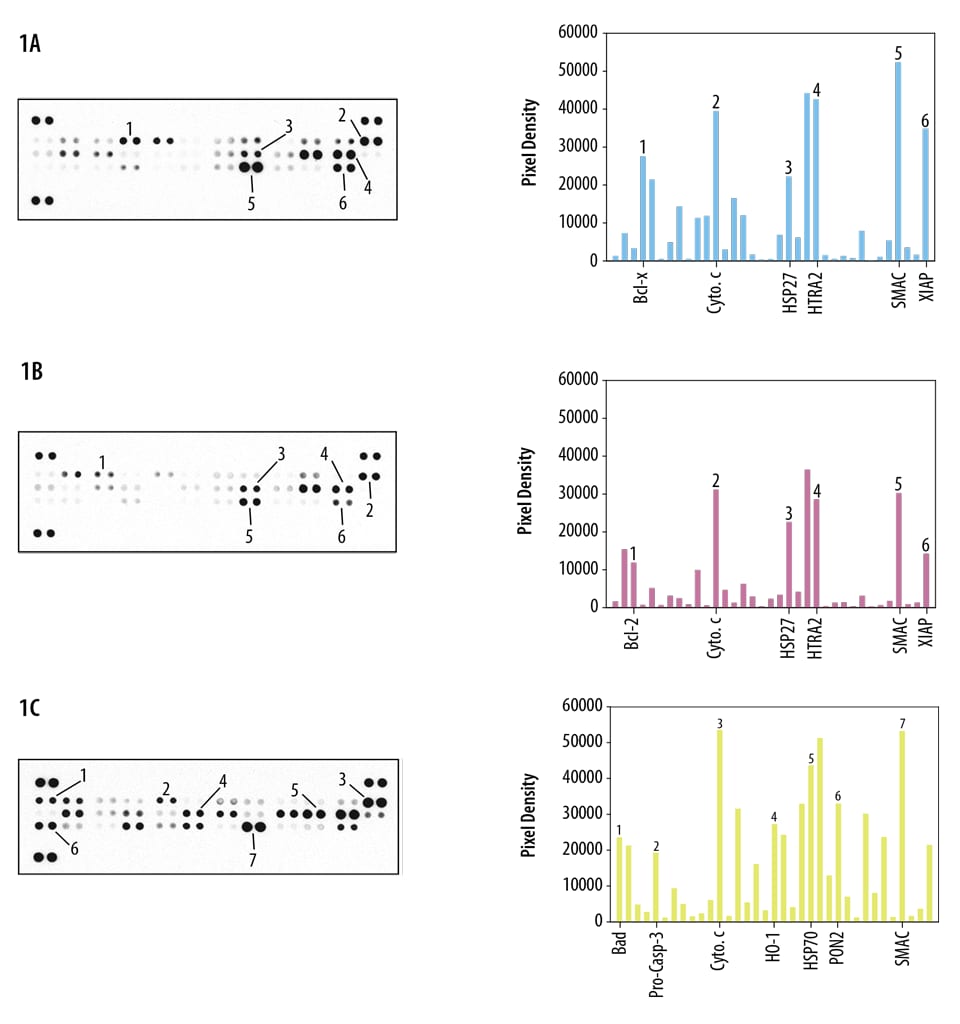
Scientific Data Images for Proteome Profiler Human Apoptosis Array Kit
Determination of Relative Levels of Human Apoptosis-related Proteins Using Proteome Profiler Human Apoptosis Array Kit.
Figure 1A: K562 human chronic myelogenous leukemia cells.Figure 1B: THP-1 human acute monocytic leukemia cells.
Figure 1C: SK-Mel-28 human malignant melanoma cells.
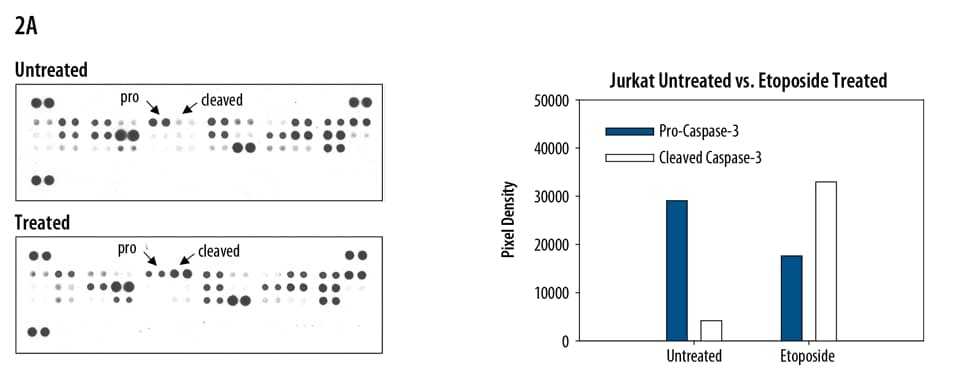
Determination of Relative Levels of Human Apoptosis-related Proteins Using Proteome Profiler Human Apoptosis Array Kit.
Jurkat human acute T cell leukemia cells were either untreated or treated with 25 µM etoposide for 6 hours. Etoposide is a topoisomerase II inhibitor that causes caspase-3 cleavage as apoptosis is induced.Formulation, Preparation, and Storage
Shipping
The product is shipped with polar packs. Upon receipt, store it immediately at the temperature recommended below.
Storage
Store the unopened product at 2 - 8 °C. Do not use past expiration date.
Background: Apoptosis Array Kit
Additional Apoptosis Array Kit Products
Product Documents for Proteome Profiler Human Apoptosis Array Kit
Certificate of Analysis
To download a Certificate of Analysis, please enter a lot or batch number in the search box below.
Note: Certificate of Analysis not available for kit components.
Product Specific Notices for Proteome Profiler Human Apoptosis Array Kit
For research use only
Related Research Areas
Citations for Proteome Profiler Human Apoptosis Array Kit
 Powered by Bioz
Customer Reviews for Proteome Profiler Human Apoptosis Array Kit (18)
4.8 out of 5
18 Customer Ratings
Have you used Proteome Profiler Human Apoptosis Array Kit?
Submit a review and receive an Amazon gift card!
$25/€18/£15/$25CAN/¥2500 for a review with an image
$10/€7/£6/$10CAN/¥1110 for a review without an image
Submit a review
Customer Images




Showing
1
-
5 of
18 reviews
Showing All
Filter By:
-
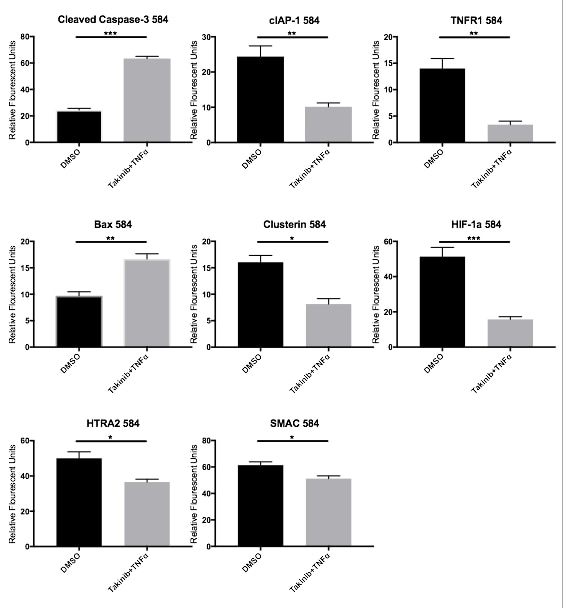
Sample Tested: MDA-MB-231 human breast cancer cell lineAssay Type: In VitroVerified Customer | Posted 02/02/2026I used this kit for in vitro experiements with breast cancer cell line. We used this kit to study the role of an ion channel.
-
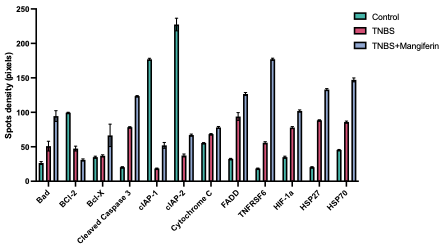
Verified Customer | Posted 01/29/2025The pro-apoptotic effect of TNBS and TNBS+Mangiferin (a bioactive flavonoid) was assayed in human-polarized THP-1 monocytes. Protein was extracted from the cells and the microarray was assayed. Untreated cells were used as a control. A strong pro-apoptotic effect was observed in the TNBS+Mangiferin treatment.

-
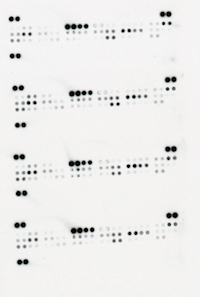
Verified Customer | Posted 12/27/2024Human Caco-2 cells were treated either with metformin or metformin + cisplatin, and the effect of these treatments (assayed IC50) was evaluated on the production of proteins related to apoptosis. Our results were very consistent between all the protein extractions, and low SD were obtained. Cells without treatment (DMEM + FBS 2 %) were used as a control cells.
-
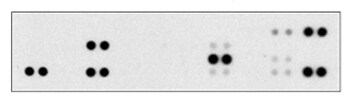
Verified Customer | Posted 11/21/2022HepG2 cell lysate, 320 ug loaded, NIR LICOR secondary antibody
-
Verified Customer | Posted 10/11/2022The kit was used in human SW480 colorectal adenocarcinoma cells treated with gold nanoparticles synthesized with Ricinus communis extracts. Several pro-apoptotic proteins were modulated by the nanoparticles, inducing apoptosis in the cells.
-
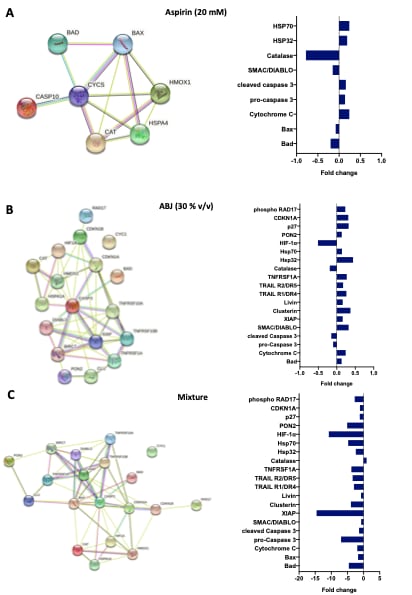
Verified Customer | Posted 09/23/2021Apoptosis array was used to evaluate the pro-apoptotic effect of a South American berry on human colon adenocarcinoma cancer cells (SW480). The kit was very easy to use, all steps are very clear, and results were very consistent. These results were used for a manuscript that is currently under review. We definitively would buy this array to be assayed not only for cell culture but also for tissues. The figure shown depicts the impact of three samples (Aspirin, the South American berry or ABJ, and their combination) in the modulation of pro-apoptotic proteins from this kit.
-
Verified Customer | Posted 10/20/2020
-
Verified Customer | Posted 02/07/2019
-
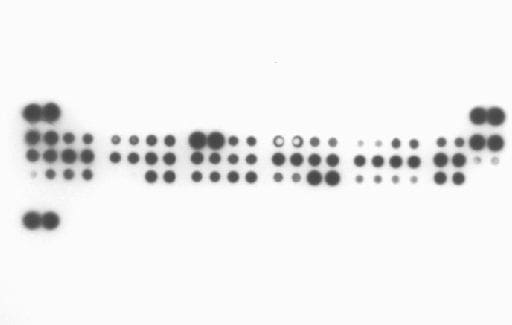
Verified Customer | Posted 12/12/2018COLO 205 cancer cells were drug treated and vehicle and apoptosis proteins analyzed. 3 minute exposure time.
-
Verified Customer | Posted 12/11/2018
-
Verified Customer | Posted 12/11/2018
-
Verified Customer | Posted 09/13/2018Very nice kit with easy to follow protocol. Good tool for discovery biology. We used to test small molecule induction of apoptosis in breast cancer cells. I would recommend this kit to anyone looking to profile multiple apoptosis pathways at once. Spot placement was very consistent which made analysis easy.
-
Verified Customer | Posted 01/12/2018
-
Verified Customer | Posted 10/31/2017
-
Verified Customer | Posted 10/31/2017
-
Verified Customer | Posted 09/07/2017
-
Verified Customer | Posted 01/03/2017This array is an excellent tool for screening potential apoptosis related targets. However, it would be nice that if more common targets can be included, e.g. tBid, cleaved PARP and cleaved Caspase9.
-
Sample Tested: Tumor cell lyastesVerified Customer | Posted 10/26/2015These are arrays are used to determine the changes in the expression of proteins of different apoptotic pathways. The signal is quantified to detect the changes. Protocol instructions are good and easy to follow. <br />Specificity: Reasonably specific<br />Sensitivity: Reasonably sensitive<br />Buffer: BSA<br />Dilution: 1:1000
There are no reviews that match your criteria.
FAQs
No product specific FAQs exist for this product.
View all FAQs for Proteome Profiler Antibody ArraysLoading...